Introduction
Understanding how to calculate your car's fuel consumption is essential for monitoring your vehicle's efficiency and managing your transportation costs. Fuel consumption, typically measured in miles per gallon (MPG) in the United States or liters per 100 kilometers in other countries, provides valuable insight into your vehicle's performance and can help you identify potential issues.
Fuel efficiency varies significantly based on numerous factors, including driving habits, vehicle maintenance, road conditions, and environmental factors. By learning how to calculate and track your fuel consumption, you can make informed decisions about your driving style, maintenance schedule, and even when it might be time to consider a more fuel-efficient vehicle.
This comprehensive guide will walk you through the process of calculating fuel consumption, explain the various factors that affect fuel efficiency, and provide practical tips for improving your vehicle's MPG. Whether you're a new driver or an experienced motorist, understanding fuel consumption can save you money and reduce your environmental impact.
How It Works: Calculating Fuel Consumption
The MPG Calculation Method
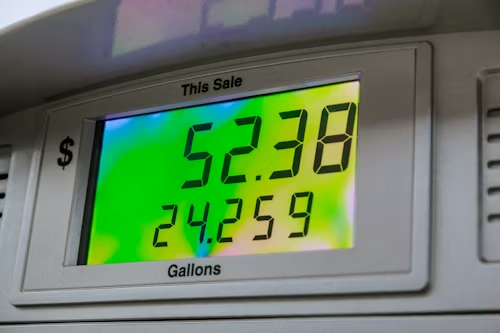
Calculating your vehicle's fuel consumption in miles per gallon (MPG) is straightforward. Start by filling your fuel tank completely and resetting your trip odometer to zero. Drive normally until you need to refuel, then fill the tank again. Note the number of miles driven and the number of gallons needed to refill the tank.
To calculate MPG, divide the miles driven by the gallons of fuel used. For example, if you drove 300 miles and used 10 gallons of fuel, your MPG would be 30. This calculation provides your actual fuel efficiency under real-world driving conditions, which may differ from the manufacturer's advertised figures.
For the most accurate results, repeat this process several times and calculate the average. This helps account for variations in driving conditions and fuel quality. Keeping a log of your fuel consumption over time can reveal trends and help you identify changes in your vehicle's efficiency.
Liters per 100 Kilometers
In many countries, fuel consumption is measured in liters per 100 kilometers (L/100km). To calculate this, you'll need to track the distance driven in kilometers and the fuel used in liters. The formula is: (liters used / kilometers driven) × 100.
For example, if you used 8 liters of fuel to drive 100 kilometers, your consumption would be 8 L/100km. This measurement system is more intuitive for comparing fuel efficiency because lower numbers indicate better efficiency, unlike MPG where higher numbers are better.
Using Onboard Computers
Modern vehicles often include onboard computers that display real-time and average fuel consumption. These systems use sensors to measure fuel flow and distance traveled, providing instant feedback on your driving efficiency. While convenient, these systems may not be as accurate as manual calculations.
Onboard computers can be useful for monitoring your driving habits and seeing how different conditions affect fuel efficiency. However, for precise tracking and comparison, manual calculations using the fill-up method remain the gold standard for accuracy.
Understanding Manufacturer Ratings
Vehicle manufacturers provide estimated fuel efficiency ratings based on standardized testing procedures. These ratings are typically broken down into city, highway, and combined MPG figures. While useful for comparing vehicles, real-world fuel efficiency often differs from these laboratory-based estimates.
Factors such as driving style, traffic conditions, weather, and vehicle maintenance all affect actual fuel consumption. Your real-world MPG may be lower or higher than the manufacturer's ratings depending on these variables. Understanding this difference helps set realistic expectations for your vehicle's performance.
Components and Functions: Factors Affecting Fuel Consumption
Driving Habits
Your driving style has the most significant impact on fuel consumption. Aggressive acceleration, hard braking, and excessive speeding all reduce fuel efficiency. Smooth, gradual acceleration and anticipating stops to avoid hard braking can improve MPG by up to 30%.
Speed is another critical factor. Most vehicles achieve optimal fuel efficiency at speeds between 45 and 65 mph. Driving at higher speeds increases aerodynamic drag and engine load, significantly reducing fuel economy. Using cruise control on highways can help maintain a steady, efficient speed.
Vehicle Maintenance
Proper maintenance is essential for optimal fuel efficiency. Underinflated tires increase rolling resistance, forcing the engine to work harder and consume more fuel. Check your tire pressure regularly and maintain it at the manufacturer's recommended level.
Engine performance directly affects fuel consumption. Dirty air filters restrict airflow to the engine, reducing efficiency. Spark plugs that are worn or fouled can cause incomplete combustion. Regular oil changes using the recommended viscosity ensure proper engine lubrication and reduce friction.
Aerodynamics and Vehicle Design
Aerodynamic drag is a significant factor in fuel consumption, especially at highway speeds. Vehicles with sleek, aerodynamic designs experience less air resistance and therefore require less fuel to maintain speed. Roof racks, cargo boxes, and open windows increase drag and reduce efficiency.
Vehicle weight also plays a crucial role. Heavier vehicles require more energy to accelerate and maintain speed. Carrying unnecessary cargo in your trunk or on the roof increases fuel consumption. Removing excess weight can improve MPG, particularly for stop-and-go driving.
Environmental Conditions
Weather and road conditions significantly affect fuel efficiency. Cold weather increases fuel consumption as engines take longer to reach optimal operating temperature. Winter fuel blends also contain less energy than summer blends, further reducing efficiency.
Terrain and road surface impact fuel consumption. Driving uphill requires more power, while downhill driving can improve efficiency. Rough or unpaved roads increase rolling resistance. Traffic conditions also matter; stop-and-go driving in congested areas is much less efficient than steady highway cruising.
Air Conditioning and Accessories
Using air conditioning increases fuel consumption by putting additional load on the engine. At low speeds, rolling down windows may be more efficient, but at highway speeds, open windows create significant aerodynamic drag that can be worse than running the AC.
Other electrical accessories, such as heated seats, defrosters, and entertainment systems, also consume power and can reduce fuel efficiency. Using these accessories judiciously and turning them off when not needed helps maintain optimal fuel economy.
Applications / Real-World Examples: Fuel Consumption in Different Scenarios
City Driving
City driving typically results in lower fuel efficiency due to frequent stops, starts, and idling. The constant acceleration and braking consume more fuel than steady cruising. Hybrid vehicles excel in city driving because they can recover energy during braking and operate on electric power at low speeds.
Strategies for improving city fuel efficiency include anticipating traffic flow to minimize stops, avoiding rapid acceleration, and turning off the engine when stopped for extended periods. Some modern vehicles feature automatic start-stop systems that shut off the engine when the vehicle is stationary.
Highway Driving
Highway driving generally offers better fuel efficiency than city driving because the engine operates at a steady, efficient speed. However, excessive speed increases aerodynamic drag dramatically, reducing MPG. Maintaining a moderate, steady speed is key to maximizing highway fuel economy.
Using cruise control can help maintain a constant speed and prevent unintentional speeding. Drafting behind larger vehicles (at a safe distance) can reduce aerodynamic drag and improve efficiency, though this practice requires caution and should only be done when safe and legal.
Hybrid Vehicles
Hybrid vehicles combine gasoline engines with electric motors to achieve superior fuel efficiency. The electric motor provides assistance during acceleration and can power the vehicle alone at low speeds. Regenerative braking captures energy that would otherwise be lost and stores it in the battery.
Hybrids typically achieve their best fuel economy in city driving where the electric motor can do more work. However, modern hybrids have also improved highway efficiency through advanced power management systems. Understanding how your hybrid's systems work can help you maximize its fuel-saving potential.
Diesel Vehicles
Diesel engines are generally more fuel-efficient than gasoline engines due to higher compression ratios and greater energy density in diesel fuel. Diesel vehicles often achieve 20-30% better fuel economy than their gasoline counterparts, making them popular for drivers who cover many miles.
Modern diesel engines also produce more torque at lower RPMs, which can improve efficiency in certain driving conditions. However, diesel fuel is typically more expensive than gasoline, so the overall cost savings depend on local fuel prices and driving patterns.
Real-World Examples
For example, modern engines use direct injection to spray fuel directly into the combustion chamber, improving efficiency by up to 15%.
Autonomous vehicles use multiple sensors including LiDAR, radar, and cameras to create a 360-degree view of their surroundings.
The average modern car contains over 30,000 parts and 100 million lines of code.
Data and Statistics
According to IEEE, approximately 95% of modern vehicle functions are related to electronic control systems.
Source: IEEE
According to NHTSA, approximately 94% of serious crashes are related to human error (potential for autonomous improvement).
Source: NHTSA
Practical Checklist
- Understand the system's basic operation
- Identify key components and their functions
- Know the system's limitations
- Follow manufacturer specifications
- Use proper diagnostic tools
Frequently Asked Questions
Q: What is the difference between autonomous driving levels?
A: There are 6 levels of autonomous driving (0-5). Level 0 has no automation, Level 1 has driver assistance (like cruise control), Level 2 has partial automation (like Tesla Autopilot), Level 3 has conditional automation, Level 4 has high automation, and Level 5 is fully autonomous with no human intervention needed.
Q: How does a hybrid car's battery work?
A: Hybrid cars use a high-voltage battery pack (usually nickel-metal hydride or lithium-ion) to store energy captured during braking (regenerative braking) and from the engine. This stored energy powers an electric motor that assists the gasoline engine, improving fuel efficiency and reducing emissions.
Technical Deep Dive
Let's explore the technical aspects in greater detail. Understanding the underlying principles and mechanisms provides a foundation for more advanced automotive knowledge and practical applications.
Key Technical Principles
- Principle 1: The fundamental physics and engineering concepts that govern this system
- Principle 2: How these principles are applied in real-world scenarios
- Principle 3: The mathematical and scientific foundations behind the technology
Advanced Applications
Modern applications of this technology have evolved significantly. Current implementations include sophisticated control systems, advanced materials, and integration with other vehicle systems. These advancements have improved efficiency, safety, and performance dramatically.
Visual Learning Resources
While this article provides comprehensive text explanations, visual aids can enhance understanding. Consider the following resources for additional learning:
- Diagrams: Look for technical diagrams showing component relationships and system interactions
- Infographics: Visual representations of data and statistics help grasp complex information quickly
- Video Tutorials: Step-by-step video demonstrations provide practical guidance
- Interactive Simulations: Online tools allow you to experiment with concepts safely
These resources complement the written content and cater to different learning styles. Visual learners particularly benefit from diagrams and infographics, while hands-on learners may prefer video tutorials and simulations.
Conclusion
Understanding and monitoring your car's fuel consumption is essential for managing transportation costs and reducing environmental impact. By calculating your MPG regularly, you can track your vehicle's efficiency, identify potential issues, and measure the effectiveness of fuel-saving strategies.
The factors affecting fuel consumption are numerous and interconnected. Your driving habits, vehicle maintenance, and the conditions in which you drive all play significant roles in determining your actual fuel efficiency. Making small changes in these areas can lead to substantial improvements in MPG over time.
Whether you're trying to save money on fuel, reduce your carbon footprint, or simply understand your vehicle better, tracking fuel consumption provides valuable insights. The knowledge gained from monitoring your MPG empowers you to make informed decisions about your driving and maintenance practices.
As fuel prices continue to fluctuate and environmental concerns grow, fuel efficiency becomes increasingly important. By understanding how to calculate and improve your vehicle's fuel consumption, you can take control of your transportation costs and contribute to a more sustainable future.