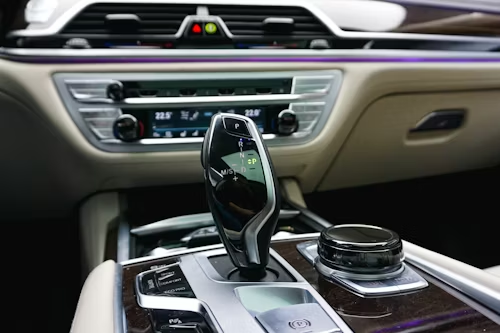
Introduction
Modern vehicles are marvels of electronic engineering, incorporating sophisticated systems that enhance safety, improve performance, and provide greater convenience. From basic electronic fuel injection to advanced driver assistance systems, automotive electronics have transformed how we drive and interact with our vehicles.
The evolution of car electronics has been dramatic over the past few decades. What began with simple electronic ignition systems has evolved into complex networks of sensors, processors, and actuators that control virtually every aspect of vehicle operation. These systems work together seamlessly to provide safer, more efficient, and more enjoyable driving experiences.
Understanding modern car electronics is essential for anyone who wants to appreciate the technology behind today's vehicles. This comprehensive guide will explore the various electronic systems found in modern cars, from essential safety features like ABS and ESP to advanced driver assistance systems that are paving the way toward autonomous driving.
How It Works: The Foundation of Automotive Electronics
The Electronic Control Unit (ECU)
The Electronic Control Unit serves as the brain of modern vehicles, processing data from numerous sensors and controlling various systems. Modern cars contain multiple ECUs, each responsible for specific functions such as engine management, transmission control, braking, and safety systems. These ECUs communicate through networks like CAN bus to share information and coordinate operations.
ECUs use sophisticated algorithms to make real-time decisions based on sensor inputs. For example, the engine control module adjusts fuel injection, ignition timing, and valve timing based on throttle position, engine speed, temperature, and oxygen sensor readings. This precise control optimizes performance, fuel economy, and emissions.
Sensor Technology
Sensors are the eyes and ears of automotive electronics, providing the data that ECUs need to make informed decisions. Modern vehicles contain dozens of sensors measuring everything from engine temperature and pressure to vehicle speed and steering angle. These sensors provide continuous feedback that enables precise control of vehicle systems.
Common sensors include wheel speed sensors for ABS and traction control, throttle position sensors for engine management, and radar and camera sensors for advanced driver assistance systems. The accuracy and reliability of these sensors are critical for proper system operation. Modern sensors are highly sophisticated, often incorporating self-diagnostic capabilities to detect failures.
Actuators and Control Systems
While sensors provide information, actuators execute the commands from ECUs. These devices convert electronic signals into physical actions. Examples include fuel injectors that spray fuel into the engine, electronic throttle bodies that control airflow, and brake actuators in ABS systems that modulate brake pressure.
Modern actuators are incredibly precise, capable of making minute adjustments in milliseconds. This precision enables sophisticated control strategies that were impossible with mechanical systems. The combination of accurate sensors, powerful processors, and precise actuators creates closed-loop control systems that continuously monitor and adjust vehicle operation.
Components and Functions: Essential Safety Systems
Anti-Lock Braking System (ABS)
ABS is one of the most important safety advances in automotive history. It prevents wheel lockup during hard braking by rapidly modulating brake pressure to each wheel individually. This allows the driver to maintain steering control while braking, significantly reducing stopping distances on most surfaces.
Wheel speed sensors detect when a wheel is about to lock up. The ABS controller then reduces brake pressure to that wheel, allowing it to regain traction. This process can occur dozens of times per second, far faster than any human could pump the brakes. Modern ABS systems are highly sophisticated, incorporating algorithms for various road conditions and driving situations.
Electronic Stability Program (ESP)
ESP, also known as Electronic Stability Control (ESC), helps prevent loss of control by detecting and correcting skids. The system compares the driver's intended direction (based on steering wheel angle and throttle position) with the vehicle's actual direction (measured by yaw rate and lateral acceleration sensors).
If the vehicle begins to deviate from the intended path, ESP selectively applies brakes to individual wheels and adjusts engine power to help bring the vehicle back under control. This system is particularly effective in preventing rollovers and maintaining control during emergency maneuvers. ESP has been shown to reduce single-vehicle crashes by up to 50%.
Traction Control System (TCS)
Traction control prevents wheel spin during acceleration by reducing engine power or applying brakes to spinning wheels. This system is especially useful in slippery conditions or when accelerating from a stop. By maintaining traction, TCS improves acceleration and helps the driver maintain control.
Traction control works similarly to ABS but focuses on acceleration rather than braking. When wheel speed sensors detect excessive wheel spin, the system intervenes by reducing throttle or applying brake pressure to the spinning wheel. Modern TCS systems are integrated with ESP and ABS, sharing sensors and control strategies for optimal performance.
Advanced Driver Assistance Systems (ADAS)
ADAS represents the next generation of automotive safety technology, using cameras, radar, and other sensors to monitor the vehicle's environment and assist the driver. These systems include adaptive cruise control, lane departure warning, blind spot monitoring, and automatic emergency braking.
Adaptive cruise control maintains a set distance from the vehicle ahead by automatically adjusting speed. Lane departure warning alerts the driver if the vehicle drifts out of its lane. Blind spot monitoring detects vehicles in the driver's blind spots. Automatic emergency braking can apply the brakes if a collision is imminent and the driver doesn't react.
Applications / Real-World Examples: Electronics in Action
Everyday Driving
In everyday driving situations, automotive electronics work continuously to enhance safety and comfort. The engine management system optimizes fuel economy and emissions while providing smooth power delivery. The transmission control module shifts gears at optimal times for efficiency and performance. The climate control system maintains comfortable cabin temperature.
These systems operate seamlessly in the background, requiring no input from the driver. However, they significantly impact the driving experience. Modern vehicles are more efficient, more comfortable, and safer than their predecessors thanks to these electronic systems.
Emergency Situations
During emergency situations, electronic safety systems can be life-saving. ABS helps maintain steering control during panic braking, allowing the driver to avoid obstacles. ESP helps prevent loss of control during sudden maneuvers. Automatic emergency braking can prevent collisions or reduce their severity.
These systems react far faster than human drivers, often making the difference between a close call and a serious accident. The widespread adoption of these systems has contributed significantly to the decline in traffic fatalities over recent decades.
Adverse Weather
Electronic systems are particularly valuable in adverse weather conditions. Traction control helps maintain grip on slippery surfaces. ESP helps prevent skids on wet or icy roads. ABS maintains steering control during braking on snow or ice. These systems make driving safer in challenging conditions.
Modern vehicles also include electronic systems specifically designed for adverse weather. Rain-sensing wipers automatically adjust speed based on precipitation. Automatic headlights turn on when visibility is poor. These features reduce driver workload and improve safety in poor weather.
Performance Driving
Performance vehicles use advanced electronics to enhance driving dynamics and safety. Launch control systems optimize acceleration from a standstill. Performance-oriented ESP modes allow controlled drifts while maintaining safety. Electronic differentials distribute torque between wheels for optimal grip.
These systems make high-performance driving more accessible and safer. They allow drivers to explore the vehicle's capabilities while providing a safety net that prevents loss of control. The result is more enjoyable and safer performance driving.
Real-World Examples
For example, a typical 2.0L four-cylinder engine produces around 150-200 horsepower.
Consider the Toyota Prius, which uses a hybrid system to achieve over 50 MPG.
The Ford F-150's 3.5L EcoBoost V6 engine produces 400 horsepower while maintaining good fuel efficiency.
Data and Statistics
According to SAE International, approximately 90% of modern engines are related to advanced materials and manufacturing techniques.
Source: SAE International
According to EPA, approximately 25% of fuel efficiency improvements are related to hybrid technology.
Source: EPA
Practical Checklist
- Check the engine oil level and condition
- Inspect the air filter for dirt and debris
- Verify coolant level and quality
- Check all belts and hoses for wear
- Inspect spark plugs for wear or damage
Frequently Asked Questions
Q: What is the most common cause of engine failure?
A: The most common cause of engine failure is lack of proper maintenance, particularly not changing the oil regularly. Dirty oil can cause excessive wear on engine components, leading to premature failure.
Q: How often should I change my engine oil?
A: Most manufacturers recommend changing your oil every 5,000 to 7,500 miles for conventional oil, or every 10,000 to 15,000 miles for synthetic oil. Always check your owner's manual for specific recommendations.
Technical Deep Dive
Let's explore the technical aspects in greater detail. Understanding the underlying principles and mechanisms provides a foundation for more advanced automotive knowledge and practical applications.
Key Technical Principles
- Principle 1: The fundamental physics and engineering concepts that govern this system
- Principle 2: How these principles are applied in real-world scenarios
- Principle 3: The mathematical and scientific foundations behind the technology
Advanced Applications
Modern applications of this technology have evolved significantly. Current implementations include sophisticated control systems, advanced materials, and integration with other vehicle systems. These advancements have improved efficiency, safety, and performance dramatically.
Visual Learning Resources
While this article provides comprehensive text explanations, visual aids can enhance understanding. Consider the following resources for additional learning:
- Diagrams: Look for technical diagrams showing component relationships and system interactions
- Infographics: Visual representations of data and statistics help grasp complex information quickly
- Video Tutorials: Step-by-step video demonstrations provide practical guidance
- Interactive Simulations: Online tools allow you to experiment with concepts safely
These resources complement the written content and cater to different learning styles. Visual learners particularly benefit from diagrams and infographics, while hands-on learners may prefer video tutorials and simulations.
Conclusion
Modern car electronics have transformed vehicles from simple mechanical machines into sophisticated computer-controlled systems. From essential safety features like ABS and ESP to advanced driver assistance systems that are paving the way toward autonomous driving, these technologies have made driving safer, more efficient, and more enjoyable.
The evolution of automotive electronics continues at a rapid pace. Each new generation of vehicles incorporates more sophisticated systems with greater capabilities. Artificial intelligence and machine learning are being integrated into vehicle systems, enabling more advanced features and better performance.
Understanding these electronic systems provides valuable insight into how modern vehicles work and why they perform the way they do. Whether you're a car enthusiast, a new driver, or simply curious about automotive technology, appreciating the complexity and sophistication of modern car electronics enhances your understanding of the remarkable engineering behind today's vehicles.
As we look to the future, automotive electronics will continue to evolve, bringing new capabilities and improving existing systems. The journey toward fully autonomous vehicles is well underway, with each advancement in electronic technology bringing us closer to that goal. Understanding these systems today helps us prepare for the changes ahead and appreciate the remarkable progress that has already been made.